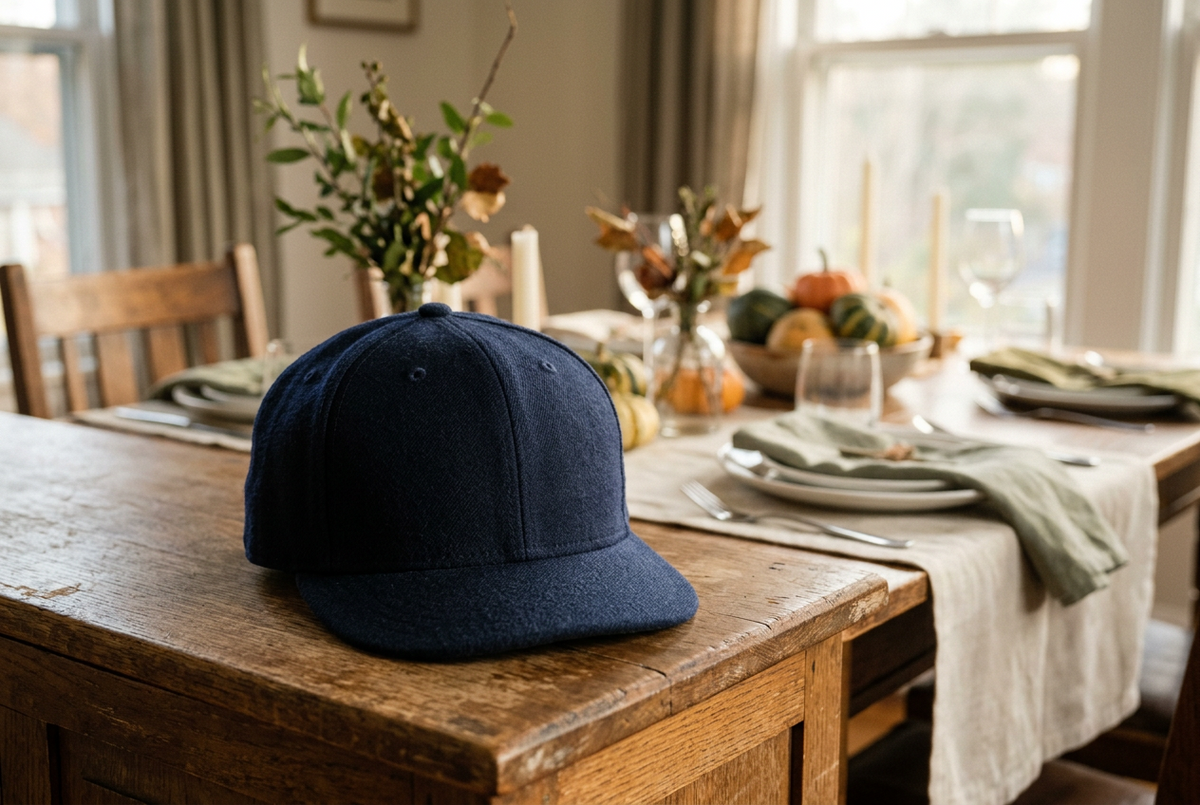

Somebody always shows up to Thanksgiving in a fitted. In my family, that's me, and I'm never the only one. We walk in, hug everybody, catch up, and work through the snacks with the cap still on. Then it's time for grace.
And in plenty of houses, that's when somebody's grandmother starts giving looks.
Every family has this moment. Every year. So let's settle what the rule actually says, where it came from, and what we think about it.
What the rule actually says
The Emily Post Institute has been the referee on this stuff for about a century, and their hat guidance is pretty specific. Baseball caps are included. The list of hats-off moments covers homes, the national anthem, and "at mealtimes, at the table."
So yes. Officially, the cap comes off when the turkey hits the table.
But here's the part people skip. The same list says hats can stay on "at athletic events (indoors or out)." Outdoors, on public transportation, in airport lobbies. The rule was never "hats are rude." The rule is about where you are and who you're with.
Which is how you end up with the most Thanksgiving argument possible. Bears and Lions kick off at noon Central. Eagles and Cowboys follow at 3:30. Chiefs and Bills take the night. Your uncle will tell you the living room is technically an athletic event for about nine hours.
It isn't. But we respect the effort.
Where it came from
The origin story everybody repeats goes back to knights. Emily Post tells it too: a knight who met someone and didn't lift his visor was signaling he wasn't a friend, and that could go badly. Showing your face was showing you came in peace. Over a few centuries, the helmet became a hat, and lifting it became a habit of respect.
Is that the full history? Probably not. Customs like this rarely have one clean starting point. But the idea underneath it holds up: taking your hat off says you're not in a hurry to leave. You're here. You're staying for dinner.
That's the whole reason the table is on the list. A meal at somebody's house is about as "staying" as it gets.
Speaking of Thanksgiving hats people get wrong: the tall black Pilgrim hat with the buckle is mostly a 19th-century picture. The real hat, the capotain, never had a buckle on the front. But that's a story for another day.
How we do it at our house
Caps off for grace. Back on after amen.
We say grace standing up, and every cap comes off for it. No debate. You just hold yours while we pray. Then amen, the caps go right back on, and we grab a plate and sit down to eat. The moment that counts gets the respect, and then it's family, a full plate, and the game in the next room.
Would Emily Post sign off on that? Not all the way. But it keeps the part of the rule that matters. You take the hat off when it means something, not because a list says so.
The other question is where the cap goes when it comes off. If you say grace standing, it's easy. Hold it by the brim for a minute and put it back on.
If your table keeps caps off for the whole meal, that's when "off" can't mean "anywhere."
Not on the floor next to the dog. Not under the pile of coats on the bed, where it gets crushed by somebody's parka. Not on the counter next to the stove, either.
Set it somewhere flat with nothing sitting on the crown. An empty chair, the sideboard, the top of a dresser. Fitted crowns hold their shape best when nothing's pressing on them.
Here's where we get practical for a second
Thanksgiving is the one day a cap spends six hours in a kitchen. Turkey since morning. Somebody frying something. A greens pot going since dawn. Fabric holds on to all of it, and by Friday your cap smells like the whole menu.
You don't need to wash it. Please don't wash it. Let it sit out overnight, crown up, in open air. If it's still carrying dinner the next morning, a quick light mist of FreshSPX™ fabric refresher on the outside, then let it dry before it goes back on. That's it.
Back to the table.
The rule isn't really about the hat
Every family has its own version of this. Some houses, the cap comes off at the door. Some houses, nobody's said a word about it since 1998. Plenty of people will be at a table this year with somebody who isn't there anymore, and would give anything to see that person's cap on the back of their chair again.
So maybe it's less about the rule and more about what the moment is. Some tables want the cap off for the whole meal. At ours, it's off for grace. Either way, the person who cooked all day gets to see your face when it counts.
Then go find the game.
So where does your table land: off for the whole meal, off for grace, or does it never come off?
Stay fresh.